
Walk down memory lane with me as I reminisce over an old class and it's connection to the current tech hype.
As a doctoral researcher, Critical AI Studies is one of my research areas. As an instructor who teaches technical and professional communication, I find that engineering students make up the bulk of my student population. Given that 98% of my students are aspiring engineers, it was imperative for us to critically evaluate the socio-technical impact of their future work.
Techno-utopianism is the belief that technology is the only route to a good society. According to American historian Howard Segal, this utopia would have interconnected transportation and communication systems powered by electricity. In this utopia, people will live and work from any location. Evgeny Morozov, a researcher in politics, society, and technology, calls it cyber-utopianism.
In The Net Delusion, Morozov explains cyber-utopianism as a "quasi-religious belief in the power of the internet to do supernatural things, from eradicating illiteracy in Africa to organizing all of the world's information, and one of the central beliefs of the Google Doctrine". Both Segal and Morozov's explanation of techno-utopianism foreground the belief that technology will save the day.
Postman & Kumodzi's arguments
To prepare students for this class, I assigned Neil Postman's talk The Surrender of Culture to Technology and Edem Kumodzi's AI & Software Engineering article. Postman was a media theorist whose prescient arguments about our relationship with technology still hold true today. Edem Kumodzi, on the other hand, is a software engineer. A theorist versus a practitioner.
The crux of Postman’s argument: technology stops being a tool and starts being a ruler. In his book, Technopoly, he chronicles technology's interactions with people and culture and the results that have come out of that.
He traces three stages of culture.
- Tool-using cultures: People control their tools.
- Technocracies: Tools start shaping social structures.
- Technopolies: Technology takes over; culture surrenders completely to technology.
A technopoly looks like this:
- Society stops questioning technology and treats it as authority.
- Information floods in with no clear purpose or meaning.
- Efficiency replaces human judgment.
- More data becomes the answer to every problem.
- Symbols, rituals, and cultural meaning are stripped away.
Kumodzi, on the other hand, homes in on the implications of this current AI-hype on software engineers. He argues that AI will not replace software engineers. For Kumodzi, forecasts of software engineers’ extinction have been prophesied whenever a technological innovation is outdoored. As proof, he traces 70 years of identical predictions:
• 1950s: COBOL would let managers write their own code
• 1970s: CASE tools would automate software development
• 1990s: Visual programming would eliminate text-based coding
• 2000s: Low-code platforms would create "citizen developers"
• 2020s: AI will finally do all the coding
From Kumodzi's argument, we can deduce that despite the hype generated about the wonders of a new feature, every wave has failed to replace engineers. Instead, every wave created more of them. Ultimately, the real work is translating human needs into working systems.
Read together, both Postman and Kumodzi reject the techno-utopian hype. Even though Postman and Kumodzi both challenge the techno-utopian hype, they focus on different problems and therefore offer different critiques. According to Postman, technology stops being a tool and starts being a ruler. In his book titled, Technopoly, Postman chronicles technology's relationship with society and details the concomitant changes that have arisen from their dalliance.
Kumodzi critiques techno-utopian predictions from inside the industry as a practitioner, whereas Postman critiques them from the outside as a theorist in academia. Using years of failed promises as evidence, Kumodzi punctures the AI hype – if history is anything to go by, then this milieu will also join the long list of false prophecies. His conclusion is optimistic. Humans adapt, engineers thrive, the work endures. He's skeptical of the hype but not necessarily of technology itself. Postman on the other hand, is unconcerned about unfulfilled promises. His focus is on how we cede our agency to technology.
How is ceding our agency connected to techno-utopianism? When we treat technology as the primary path to progress, eventually, we stop questioning it and it make decisions that humans and institutions typically make. This "tech-first" mindset gradually transfers problem-solving authority and power from humans and our decision making systems to technological systems.
It was an illuminating class session, and I was very impressed by how much it impacted the students. Many of them didn’t know the tech-hype history, and for engineers, the part about software engineers was unbelievable. I really was touched by their reflection, two quotes that I’m sharing here:

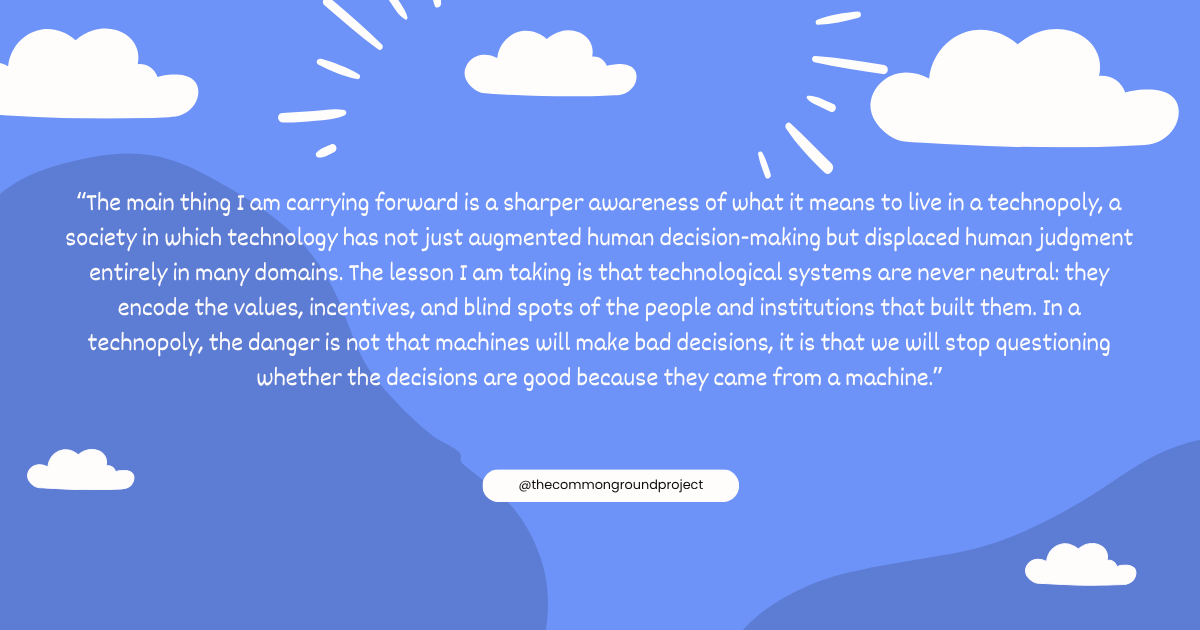
Ultimately, that was the point of the lesson: not to reject technology, but to reject the reflex that makes technology the only imaginable solution. When we understand the long history of tech hype and how easily “tools” can become authorities, we’re better positioned to ask what problem we’re actually solving, who benefits, and what gets ignored when we default to a tech-first answer. Watching the students connect these patterns to their own training was the most encouraging part of the session: they left not with cynicism, but with sharper questions, a deeper sense of responsibility, and a clearer understanding that the real work isn’t the hype—it’s translating human needs into humane, workable systems.